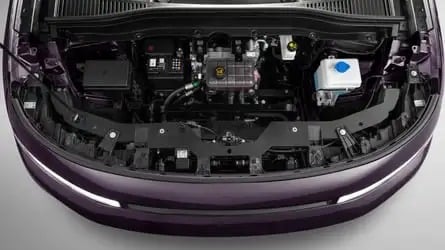
Stellantis has confirmed the development of an unprecedented flex hybrid system for the Chinese brand Leapmotor in Brazil. The technology, called REEV flex (an acronym for ‘electric vehicle with flex range extender’), uses a dual-fuel combustion engine exclusively as an energy generator for the battery, while the vehicle’s traction is made entirely by the electric propulsion.
The project is led by the South American engineering of the automotive group and will be applied to the B10 and C10 SUVs, which will be produced nationally at the Goiana Automotive Complex (PE). The strategy seeks to unite the delivery of linear and silent power of electric driving to the extensive supply infrastructure already existing in the country, using ethanol as a renewable source to mitigate the “autonomy anxiety” linked to pure electric vehicles.
Unlike conventional or plug-in hybrids, in which the combustion engine can act mechanically on the drive axle, the REEV system operates as a series hybrid. The thermal engine has no mechanical connection with the wheels; It works at optimized revs only to recharge the battery pack when the charge level drops. It is the battery that supplies energy to the rear electric motor, which in the case of the C10 SUV delivers 218 hp and 32,6 kgfm.
This configuration allows the models to achieve high running averages using the fuel tank as an energy reserve. While the gasoline version of the B10 in Europe homologates about 900 km of range, the adoption of the flex system in Brazil projects a total range close to 1,000 km for the line.
The nationalization of this technology consolidates the Pernambuco hub as Stellantis’ global development center, adapting the Chinese partner’s platform to infrastructure requirements and local biofuels.
Comments are the sole responsibility of their authors and do not represent the opinion of this site. Comments containing profanity or offensive language will not be published. If you identify anything that violates the terms of use, please report it.