

Renault and Geely unveil hybrid engine that promises 30 km/l without giant batteries
System developed by a joint venture optimizes consumption and allows converting electric platforms into hybrid ones with minimal reengineering
By
Tom Schuenk
Published on 2026-02-20 at 07:00 PM
Updated on 2026-02-20 at 08:22 PM
Published on 2026-02-20 at 07:00 PM
Updated on 2026-02-20 at 08:22 PM
Be the first to comment.
Summarize with:
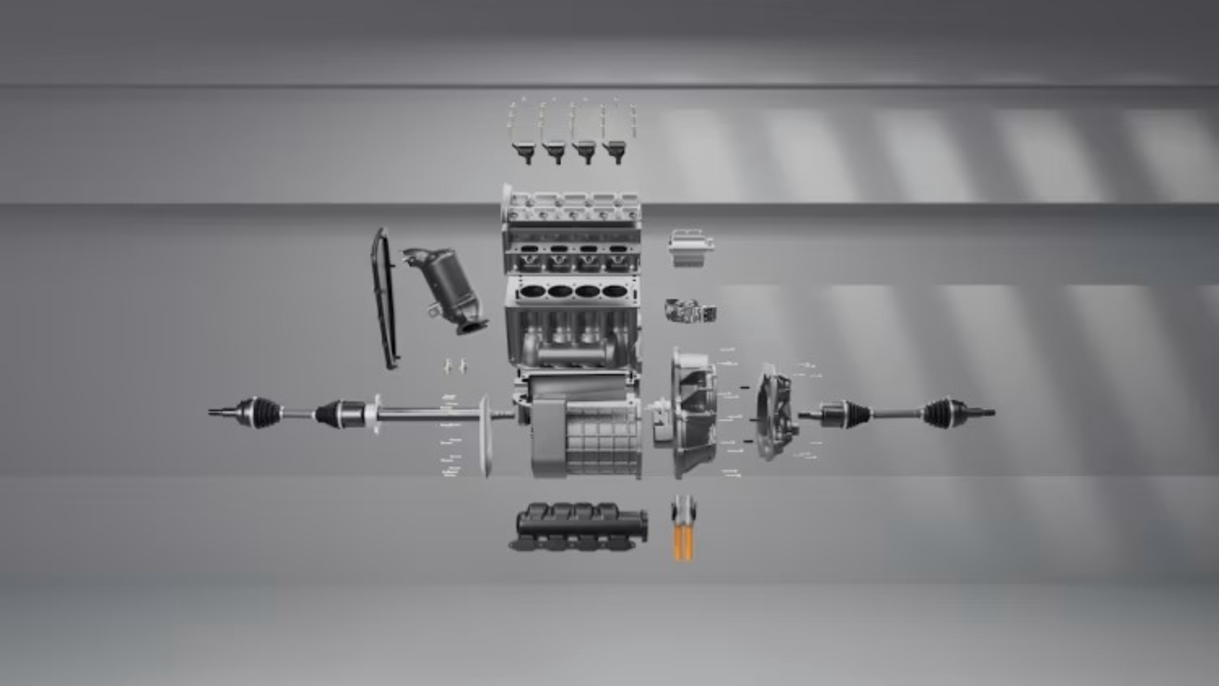
Contrary to the industry’s trend of adopting increasingly larger and heavier batteries in hybrid cars, Horse Powertrain — a joint venture formed by Renault and Geely — presented the concept of the H12 hybrid engine. Developed in partnership with the energy company Repsol, the project promises to reach the expressive mark of 30 km/l focusing only on improving internal combustion and reducing mechanical losses. The initiative emerges as a lighter, more affordable and efficient alternative for the global automotive market.
SEE ALSO:
- Young man waited for mass to start to steal cars at the door of the church in the interior of Paraná
- Apple CarPlay will have streaming playback released natively
- The world’s largest vehicle is a hybrid with 18 engines, does 0.002 km/l and carries NASA rockets to the Moon
Thermal engineering and the European cycle
The great asset of the H12 is to achieve an impressive 44.2% thermal efficiency – a rate that puts it on the same level as the most advanced hybrid systems in the world. To achieve this result, the engineers applied a very high compression ratio of 17:1, in addition to optimizing the turbocharger and exhaust gas recirculation. The set also brings a new adjustment to the hybrid transmission to ensure that the power reaches the wheels more directly and fluidly.
It is worth mentioning that the 30 km/l mark was obtained under the European WLTP test cycle, known for presenting more optimistic results than everyday use on the streets. Even so, the number far exceeds the consumption of the most sold conventional hybrids today.
Renewable gas and electric conversion
The project is also designed to run on 100% renewable gas. According to the manufacturer, this combination can reduce the annual carbon dioxide (CO2) emission of an average vehicle to just 1.77 tons. In addition to the environmental gain, Horse Powertrain bets on production versatility: its compact modules allow automakers to convert electric car platforms into hybrids with minimal reengineering, replacing the front electric motor with the new set.
With demonstration prototypes already in circulation, the company’s ultimate goal is to start large-scale production. As the technological arm of Renault and Geely, the H12 engine is expected to be integrated into the future launches of these brands, paving a more realistic energy transition in the coming years.
SEE MORE ABOUT

0 Comments
Comments are the sole responsibility of their authors and do not represent the opinion of this site. Comments containing profanity or offensive language will not be published. If you identify anything that violates the terms of use, please report it.