Memories on wheels and wings: Kombi, CB400 and Paulistinha shape a passion of the journalist who has never distanced himself from engines
My maternal grandfather, José (Zeca) Miele, was a palestrino and carpenter. I inherited only one of his virtues, since he never knew how to use a planer and the chisel always insisted on slipping from his hands. Palmeiras came into my life when I was 3 years old. I learned to read with Zeca when I was 5 years old. And playing chess and hole, at 6. But Zeca left when I was 7.
SEE ALSO:
Yolando, the other grandfather, also gave me another passion, which I was able to share until adulthood. An auto mechanic, he worked alone at home. He lived in Sorocaba (SP). On the gate of the house/workshop, there was a sign with the words “we give preference to the VW line”. Fix Opal, Chevette or Steed… only if it was from a close friend or acquaintance. He only “took service” from Beetle, Kombi, Brasília, Variant and company. She spent her holidays at his house. And I loved being his assistant. I disassembled and washed the Variant carburetors in kerosene and then went to play with the vise on the bench. I only interrupted my activity to watch him equalize the double carburetion of “ear”.
The greatest fun was, however, to go to the “Campo da Aviação”, the affectionate way he treated the Aeroclube de Sorocaba, where he had been one of the founders. He spent Saturday and Sunday mornings on the stools in front of the hangar, waiting for tourists for scenic flights in the city. Today I wonder how there were so many people who wanted to fly over So-ro-ca-ba, which, let’s face it, is a spectacular city, only seen from below. From up there it was no fun at all. Maybe because the 1970s and 1980s didn’t offer so many attractions on weekends, I don’t know.
I inherited Yolando’s passion for engines. And this trip to the “Countryside” had a double reason: the first was that I sat on his lap and handled the steering wheel and gearbox of the Kombi 1200 ́59, his daily car. At 11, he asked if I knew how to handle the pedals – of course I did, from watching so much. I left without letting the engine die. He smiled, proud. I don’t forget that.
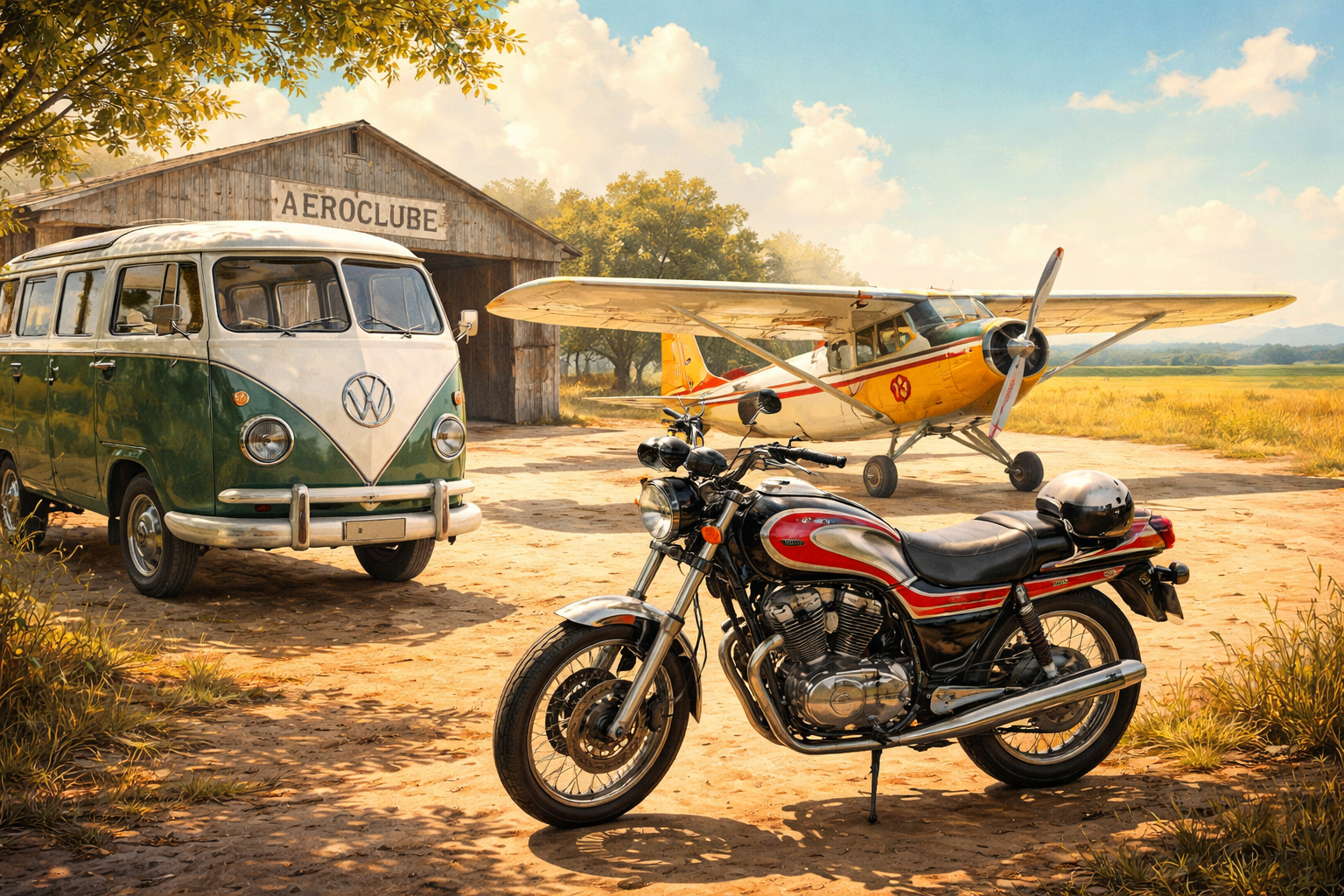
In 1982, Edson (my father) was awarded by draw at the National Honda Consortium and took a CB400 zero km – black with red stripes. We always went to Sorocaba as a family – him, my mother, my sister and I. Once, I don’t remember why, he put me on the pillion and we went there, just him and me, on a Saturday morning. We went straight to the Field. We parked on the side of the hangar, next to the Kombi. Suddenly, you know when you see three VERY COOL things in the same painting? There were Edson’s CB, Yolando’s Kombi and the Aeroclube’s Paulistinha – I’m going to talk a lot about him today. The three of them, close.
They say, in fact, that we don’t choose passions. They are the ones that involve us — sometimes, literally, in some deserted street in a country town, on the 7 km straight of Castello Branco with the wind shaking the visor of the helmet or in the dusty courtyard of the aeroclub, when Paulistinha taxied with its vigorous engine (I think it was a Continental with 4 opposed cylinders, of 90 hp).
For those who grew up with the smell of oil impregnated in their nostrils and the sound of pistons beating as if it were the rhythm of their own heart, childhood was not made of plastic toys, but of metal, grease and the promise of freedom that only engines could deliver. Looking in the rearview mirror of memory, I realize that my fate has been sealed by this trinity. I date with all this to this day. I am not a brevet. This realization was lacking. But I swear, irresponsibly I swear, that I remember every command of Paulistinha and, perhaps, I would even be able to pilot it. I flew dozens and dozens of hours with Yolando in the skies of Sorocaba. Do you want me to tell you how you fly this plane? Look and I’ll explain, huh.
Memory is visual and auditory. An interior blue sky, one of those that seem hand-painted, and the rhythmic roar of a big Continental engine. Paulistinha CAP-4 was a worker. Made of steel tubes entangled in (I think) Eucatex-like plates, very light, he looked fragile on the ground, but in the air, he was a tireless worker. It trained most of the private pilots (PP) of that country from the 40s until who knows when. If you fool around, you’re still flying.
It only has two seats. And the pilot sits in the back seat. But what does it mean to position yourself in the front seat for an 8 or 9-year-old boy? “I’m the one who will direct”. Man, how that thrills me! I have felt few joys in life like the experience of feeling like I was flying a plane.
The runway of the aeroclub was made of dirt. I remember when Yolando would give the engine at the head and start to gain speed, shaking by the imperfections of the floor. And when the tail went up? “Man, this fucking thing is going to take off…” There’s a tear here, seriously.
Paulistinha taught me the elegance of simplicity. There was no electronics. It was the joystick (a single lever, between the legs, stuck in the floor), the pedals and the sensitivity. That plane teaches that, in order to fly, you need to understand the wind, know the machine technically, respect it and have R$ 25 thousand to get a license. Fear of teco-teco? In time: teco-teco is the lightning bolt that breaks them. Fear, I only have ignorance. Paulistinha was the best.
If riding the Paulistinha was a playful dream, but one that I never really managed to fulfill, the Kombi 1200 stood out for being an achievable reality from an early age. At 11, I already mastered the powerful 36 hp machine. If there was a lack of power, there was too much character and personality. Nothing was as charming as that for a split windshield. The VW air engine is my main soundtrack of the 70s. Nothing is as iconic as the roar of that engine. My grandfather’s Luxury Kombi was a 59, 1200 engine. Adept at “improvements”, he had filled in the side windows, changed the electrical system to 12 volts, replaced the bananas with arrows and installed an ignition key, instead of the charming little start button. The rest was all original. It was a sensory experience to drive the Kombi.
When Yolando was already retired, years later, he lent the Kombi to Edson to move his forklift workshop here in São Paulo. I helped him. We made 4 or 5 trips to load all the stuff. Another excellent “Kombi driver”, Edson began to abuse speed, when a bus closes us. She stopped. But it was a struggle. I commented on the story with Yolando. Because we returned to Sorocaba 2 or 3 weeks later. I started the Kombi and left home. When braking on the speed bump about 50 meters ahead, Edson, next to me, almost hit his forehead on the glass. Let me explain: worried about the “Kombi brake”, Yolando had no doubt: he installed a brake booster! “Now, when you want to walk like crazy in São Paulo, at least the station wagon has brakes…”, he said, in a scolding tone, to my father.
I learned to master the third of my great passions at an early age. At 16, I was already walking around the neighborhood with Edson’s CB. Moto is another conversation, doctor. It is the ultimate passion, the one that makes the blood boil and that makes you hell with the eternal dilemma: “accelerating more is cool. It’s cool, but it’s dangerous. And if it’s dangerous, it may not end up so cool.” It’s crazy more or less like that. And that persists to this day. I write this text still bewitched by the 168 hp of a Ducati I just tested. And that I went to Sorocaba. And that I came back through the same Castello Branco, with the same straight of 7 km. Look. I’m 56. May God give me health to continue enjoying these great pleasures of life for long years.
It was the beginning of my adolescence when Honda launched the CB, at the turn of the 80s. The four-stroke twin-cylinder engine rumbled like a symphony – you have to transport yourself to the 80s in order to understand this feeling. The CB400 had a velvety bass, which grew as the rev counter went up. It was the “dream machine” of the boys of my generation. I recognized her snoring from afar and stopped just to watch her pass. The imposing tank, the wide seat, the round headlight. And it brought modernities: electric start, a complete panel and a performance that, to my child’s eyes, looked like a rocket.
The CB400 taught me the meaning of the word “freedom”. And, very early, the sense of “responsibility”, because on the day Edson exchanged his CB 82 for an 84, I washed the motorcycle and went out for a ride. Because I returned with the front brake lever crooked and the dog killer grated (this term must be politically incorrect today, but I’m doing a historical rescue, so it can). What I did wrong is beside the point. But I have unquestionably learned the weight of the consequence of a mistake on a two-wheeler. That was 40 years ago. I ride fast on a motorcycle. But I never took any falls again (knock on wood 3 times).
Today, we live in the era of self-driving cars, silent electric motors, and computer-controlled airplanes. Everything is safer, more efficient. But I miss the imperfection of these machines. From Paulistinha that required an arm to land with a crosswind (Google it). From the Kombi that had no brake when loaded. From CB that required technique to brake before a corner. And not during. They are three vehicles that gave me the notion of space, speed, force vectors, mechanics, but, above all, they ignited such a great passion… that I live off of it: cars, motorcycles and, hidden, airplanes. Well, right? Passions as great as the one I inherited from Zeca. Or do you think I would end such a long text without revering Palmeiras again?