Edu Pincigher remembers the day he was cornered in a pitched battle at the Autolatina factory in Taboão because of the suspension of wages
I read weeks ago, in Estadão, that Ford would be reviewing its decision to only produce SUVs and pickup trucks and could soon resume the production of passenger cars. It is something that would correct a decision, at the very least, questionable. And I’m going to take a giant turn before I give my opinion, like “I’ve seen this movie”. I started in 1989.
SEE ALSO:
I started my career as an intern at the extinct Autolatina, when I was studying Journalism at PUC-SP. An interview at the end of 1988 was enough to win a position in the press office of the holding company, which managed Volkswagen and Ford. What is the chance of recruiting another intern who had in mind the years of launch, the displacements and the powers of the engines of the entire VW and Ford line at that time?
Before going into the story itself, it is worth the caveat: this holding company really could not work, unless the ban on imported cars (it fell in the mid-1990s) lasted for much longer. Well protected, having only two competitors in the country (GM and Fiat), VW and Ford had a very sparse flow of new technologies from headquarters. If there was no one to compete with, why invest in new things?
Heavy criticism? Because Brazilians feasted on Opal as a luxury car, Fiat cars (all) did not have a radio even as an accessory and the cheapest version of the Gol charged for the right rearview mirror as an option! Ford’s case, however, was anachronistic. All passenger cars that year used the same CHT 1.6 engine (Pampa, Belina, Del Rey and Escort), which debuted in 1983, but came from a 1940s project. Everyone! Can you imagine a single engine for all cars, without even variation in displacement!?
It was sweet the life of those who had no one to compete with.
But the market was opened in 1990. The four manufacturers knew they would need to change the methodology. Fiat brought the Tempra in 1992 and GM came from Omega a year later. In the case of Autolatina’s partners, however, there was a problem. No one from Dearborn, USA, would agree to send new products to Brazil knowing that the Germans from Wolfsburg would have access to them. And vice versa.
Result: both were orphaned of the sows and had to settle for the barter. Ford models gained the AP-1800 engine and VW models were served by the CHT. Volkswagen was presented with Apollo, Logus and Pointer (derivatives of the Ford Escort), while Ford received Versailles and Royale (came from the VW Santana) in exchange. But it was too little to compete with the imported ones and even with GM and Fiat, much more incisive in their launches.
On an afternoon in July 1990, the order came from the boss: “go to Taboão [the name of the Ford plant] and be ready, because the salaries of the striking employees will not be deposited today and there may be confusion”. To the facts: the factory committee, coordinated by the ABC Metalworkers Union, strategically orchestrated a strike in which only the 800 employees of the tooling shop would paralyze activities. They were the “red collars”. Workers from other areas, such as stamping, painting and final assembly, remained ready to work.
When the tooling shop stops, it stops everything. As in the capital/labor relationship, intelligence has always been a prerogative accepted by only one side (contains irony), the board was sorry and decided not to pay a salary to anyone. I’m talking about a headcount of 9 or 10 thousand hourly workers.
There I went to Taboão. The manager of the Press fleet, who had 150 test cars to be given to journalists, gave me a Gol GTS to make the journey. It could have been the Pampa with a one-piece leather seat (no radio, no air, no shame, no life…), which was the intern’s official car. Happy day, right?
The situation was already tense in the middle of the afternoon, when the news reached the factory commission that no one would be paid. I was in the office of the plant’s HR manager, who was, at that moment, the most hated guy on the planet, like Abel Ferreira by the São Paulo fans.
Interns do everything, right? Because they ordered me to go downstairs and enter the middle of the workers with a tape recorder to capture the speech of the union leaders. And they were not generous. “This is slutty. From now on, you are on your own. And you there, wearing a tie, who came to hear what we are saying, can say that we are no longer responsible for what happens here”. Guess who the tie was? Ah, doctor. Almost a lynching. If I wasn’t in my early 20s, some sense of self-defense and right-back speed, I would have been beaten. Or more beaten.
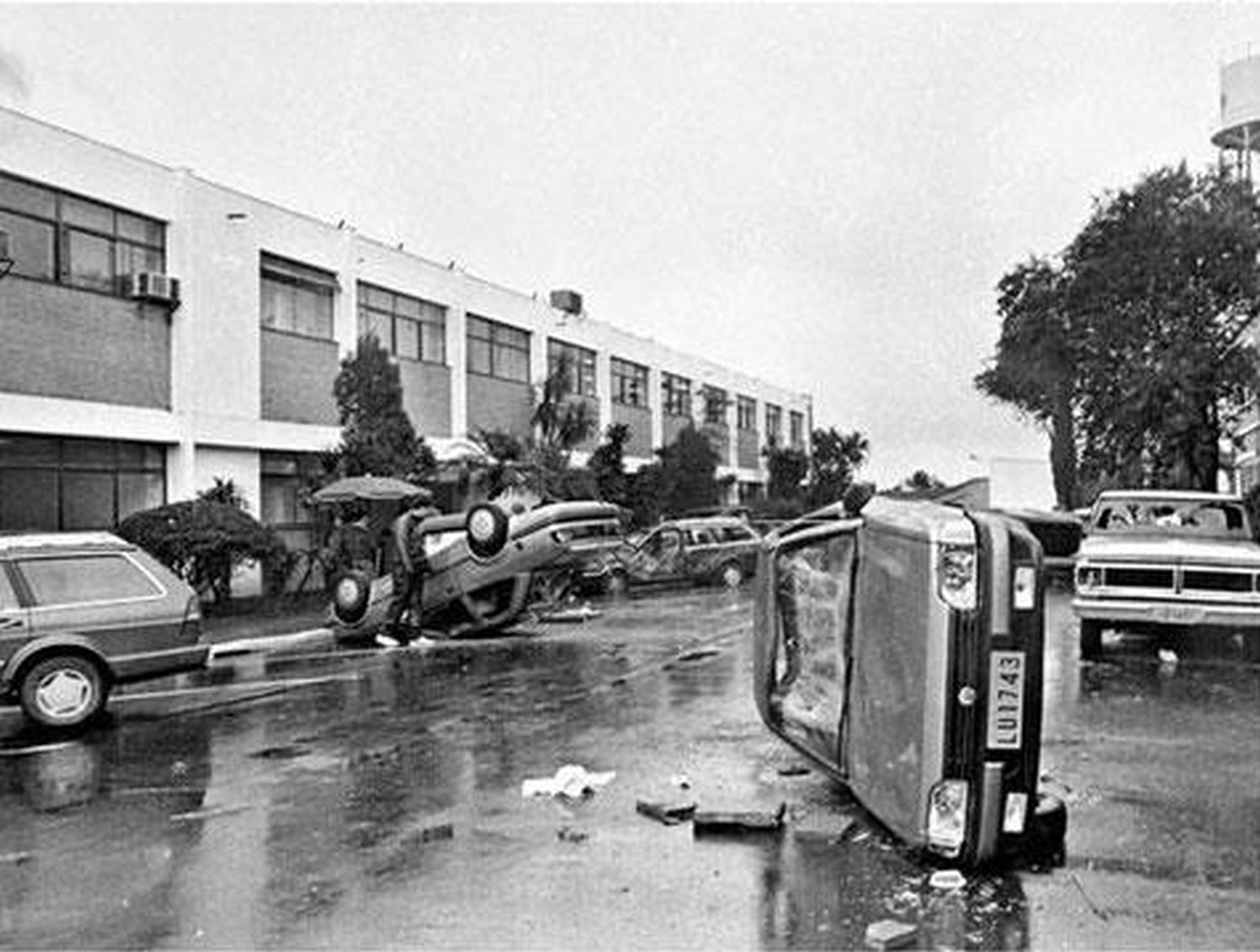
I told the HR manager: “they’re going to break everything”, when a Bosch cassette player flies through the window. The guys started to tip the cars in the yard, break the windows, take out the cassette players, fire extinguishers, monkeys (everything that was mobile) and throw them towards the HR room. At the door, two armed security guards guaranteed our physical integrity.
Moral integrity had already gone to hell: I saw half a dozen suits hidden under the tables, out of four, catatonic. As I had already been beaten… I ended up being the only one with initiative. And I called the central office asking them to send the PMSP Shock Battalion. The photo at the beginning of this column shows the result. Several cars and factory facilities were destroyed.
Adding the strike period and the renovation of the plant, Ford went two months without producing cars. A market operated by four automakers allowed you to be surgical to dose production, considering demand and stock from dealerships. But that period has expired. Ford was without manufacturing, without selling and, in that July, it was the first time historically that Fiat jumped from 4th to 3rd position in the sales ranking.
At this point, the Italian automaker was already taking the Uno Mille out of the oven, which would be launched the following month (August 1990), which also favored it to scale sales, since the ambition of the buyer of brand new cars was much greater than the deficiencies generated by a naked car of only 48 hp of power. Fiat had this engine ready, with 1,050 cm3, and it was easy to adapt it.
At Autolatina, the statement (I even disclosed this to several journalists) was that the company would not launch the “inefficient and unsafe” 1.0 cars – there was no semi-ready engine option to be reduced to 1 liter. But there was slowness, there was. And a lot! So much so that Escort Hobby would only arrive in September 1993. And Ford would never regain the 3rd position in the ranking.
The rest is history. Ford ended up interrupting production in Brazil in 2021 and adopted a premium positioning, here and in the world. At the same time, he opted globally to annihilate passenger cars, due to what, internally, he called “winners” and “loosers”. They were affectionate denominations for the vehicles of the line with greater or lesser profitability. And it is obvious that pickup trucks and SUVs belonged to the first group. They survived.
But Ford is one of the most important manufacturers of passenger cars in history. It has an incalculable tradition. The relationship I wanted to make here is simple, when I celebrated the possible return of passenger cars: when it neglected the 1000 car in Brazil, it began to shrink year by year and ended up ending production. To have killed cars around the world could make the same mistake!
More than my fans or opinion, which are only worth for you to comment below, there is another reason to wait for the return of Fiesta, Focus, Mondeo and company. Pickup trucks and SUVs will certainly, in the near future, not give the same large margins as 4 or 5 years ago. Simple: the internationalization of Chinese manufacturers will squeeze more and more of the margins of traditional brands. The profit will melt away.
Now, do you agree that it doesn’t make more sense to run out of passenger cars if the entire line-up will see its earnings drained by the competition? Returning with automobiles in this scenario, which are cheaper, may give greater economies of scale to Ford, even if the margins are not winners.