Agreement signed between the Labor Prosecutor's Office and contractors hired by BYD should pay almost R$ 90 thousand to each rescued worker
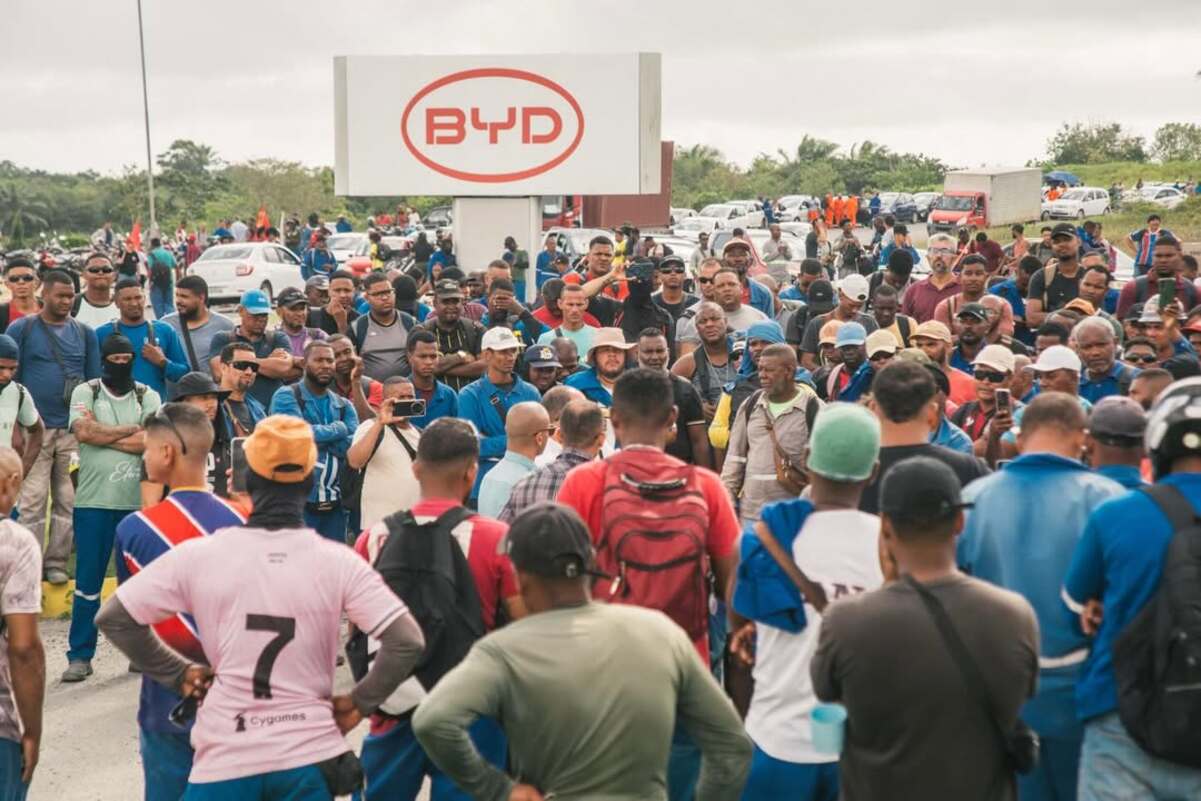
God stays long, but strikes at last. And this time it didn’t take long. After a year of the flagrant work in conditions analogous to slavery, at the works of the BYD factory, in Camaçari, the public civil action filed by the Public Ministry of Labor of Bahia (MPT-BA) was finalized with a judicial agreement of compensation to the workers and a fine, according to the blog of journalist Leonardo Sakamoto, on UOL.
SEE ALSO:
In May of this year, the MP filed a lawsuit to demand compensation from the workers. In a judicial agreement, the two contractors hired by the automaker (Jinjiang and Tecmonta) to carry out the work will have to pay a fine of R$ 40 million.
The initial amount demanded by the public prosecutor’s office exceeded R$ 250 million, but ended up being reduced to a fifth of the amount that must be paid by the contractors. Of this total, R$ 20 million will be distributed as compensation to the 224 Chinese workers. Each one should receive about R$ 89 thousand.
The other R$ 20 million will be deposited in a judicial account as collective moral damage. The amount will be allocated to social institutions that fight this type of crime, indicated by the MPT.
In a note, the MPT details the judicial agreement:
The Public Ministry of Labor (MPT) signed a judicial agreement with the automobile manufacturer BYD Auto do Brasil Ltda., China Jinjiang Construction Brazil Ltda. and Tecmonta Equipamentos Inteligentes Brasil Co. Ltda. in a public civil action (ACP) filed in May this year. The agreement provides for the payment of R$ 40 million, of which R$ 20 million is individual moral damage, intended directly to the rescued workers and another R$ 20 million is collective moral damage, which will be deposited in a judicial account for later allocation to institutions and/or funds to be indicated by the MPT. The agreement was submitted to the Labor Court for ratification, after which it will produce immediate effects.
The case involves 224 Chinese workers found in a situation analogous to slavery and victims of international human trafficking in December 2024, during the construction of BYD’s industrial plant in the municipality of Camaçari, Bahia. The workers were hired by the contractors Jinjiang and Tecmonta, which provided exclusive services to the automaker.
Under the agreement, companies assume several do’s and don’ts related to labor protection, applicable to all establishments and places in which they carry out business activity. In case of non-compliance, companies will be subject to the payment of a fine of R$ 20 thousand per injured worker and for each finding.
Of the 224 workers, 61 had returned to China without payment of the severance payments due due to the bailout. The agreement provided for the payment of terminations, of the amount related to the FGTS, with the addition of a 40% fine, in addition to compensation for individual moral damage.
Although China’s Jinjiang and Brazil’s Tecmonta are responsible for paying the fine, BYD is not free of burdens. She was listed as a kind of guarantor. That is, if the contractors default, it will be up to the automaker to assume the costs of the action.
If the measure is not complied with, the two contractors will receive new fines in the amount of R$ 20 thousand for each worker involved in the scandal, which would add another R$ 4.48 million.
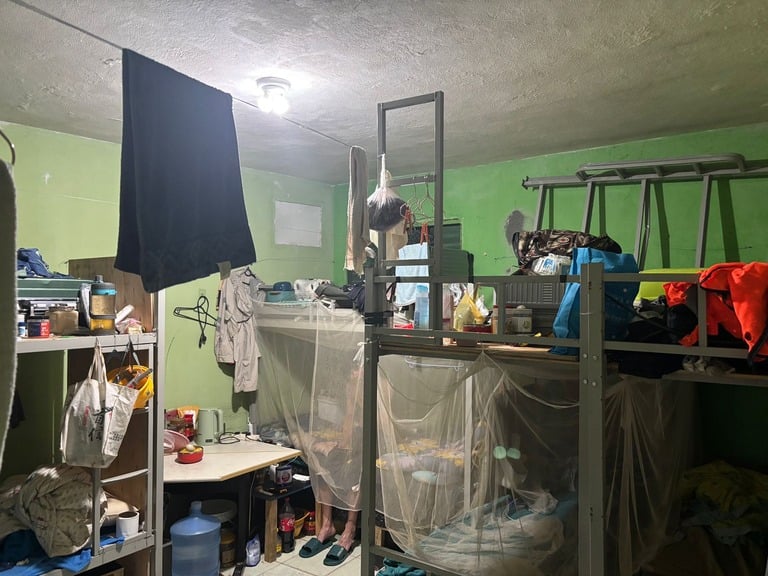
After a complaint by Agência Pública, in November 2024, a task force of the Public Ministry of Labor (MPT) and the Ministry of Labor (MTE) and Employment caught a shocking situation, on December 23 of that year: 224 Chinese workers living in precarious conditions, inside the automaker’s plant.
According to the report, the workers were housed in spaces without mattresses and closets, forced to store their belongings in an improvised way. Sanitary facilities were insufficient: there was only one toilet for every 31 people, which generated queues of up to 1h30, as well as toilets without toilet paper and, in some cases, without water to flush.
The document also points to kitchens in unsanitary conditions, with raw and cooked food stored directly on the floor and mixed with construction materials. There was no supply of drinking water, leading employees to consume tap water, nor tables for meals, which were made in bed or on the floor.
The working hours were described as exhausting, with no regular days off — one worker reported that he had not rested for 25 consecutive days. In addition, activities with high-risk tools, such as circular saws, were identified without the adequate provision of personal protective equipment (PPE).
It was also found that Chinese workers entered Brazil irregularly. All this led to the opening of the public civil action, in May 2025.
At all times, BYD defended itself by claiming that it does not condone this type of practice, recorded in a note:
BYD has been operating in Brazil for 10 years, strictly complying with local laws. The works at the plant in Camaçari, Bahia, meet all legal standards, including the installation license obtained in 2024 and approved by the state government. With an investment of R$5.5 billion, the unit has the potential to generate more than 20 thousand jobs.
JinJiang Construction Group is the construction company responsible for the works. The company has already built BYD factories in China and, as it is a very specific type of building, it operates in several countries where BYD expands operations.
We received a visit from the Labor Prosecutor’s Office, which pointed out the need for specific adjustments in the operation. We identified the non-conformities in relation to the workers in Camaçari and demanded that JinJiang act on the correction urgently. We are following the improvements closely and prioritizing the well-being of all in a daily exercise of Brazil-China cooperation.
However, labor abuses continued in Camaçari with strikes by workers demanding better working conditions, denunciations of pressure on workers to weaken the union movement, among other illegalities. The AutoPapo report contacted BYD, which did not give any official statement. However, sources within the brand guarantee that the agreement will be honored, either by the contractors, or by itself, if the parties do not comply with the agreement.



