Sequence of videos in the south zone of the capital of Amazonas shows from popular cars to immobilized buses, drawing attention to the coincidence of the problems
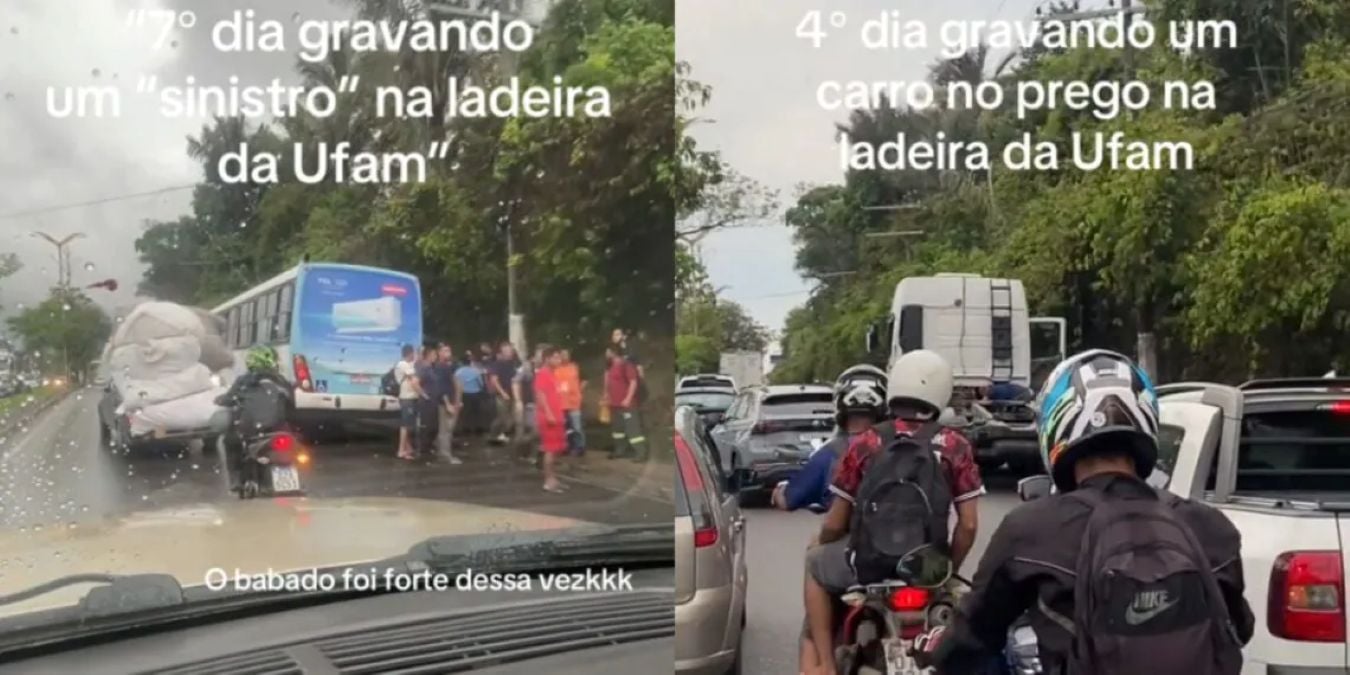
An unusual succession of mechanical failures and accidents has transformed the routine of those who travel along Avenida General Rodrigo Otávio — an important thoroughfare in Manaus. Over seven consecutive days, a passenger documented a daily series of vehicles immobilized at the site, exposing a logistical bottleneck that has generated chronic congestion and road safety risks.
The records, which gained repercussion on social networks, reveal a scenario of escalated chaos. The chronology of the incidents began with a Volkswagen Gol, which suffered a breakdown while trying to climb the slope of the road, requiring the intervention of Detran-AM agents to avoid collisions.
@edulemc Again #ufam #sinistro #ladeiradaufam #manaus #fy ♬ Poderosa – Wesley Safadão
In the following days, the diversity of affected vehicles drew attention to the traffic conditions in the region. The passenger’s “logbook” caught everything from a Fiat Strada pickup truck and a cargo truck blocking lanes to a tanker truck broken down on the same stretch, increasing the inconvenience for drivers.
SEE ALSO:
The situation worsened on the fourth day, when a pileup involving three cars blocked the avenue, generating kilometric queues. The “nail week”, as the episode has been mocked on the internet, culminated on the seventh day with a public transport bus breaking down, forcing the forced disembarkation of dozens of passengers in the middle of the road.
The recurrence of these cases raises an alert about preventive maintenance, which is often neglected. The Brazilian Traffic Code (CTB) is strict about the driver’s responsibility to avoid obstructions.
Article 253 provides penalties for those who interrupt or disturb circulation without authorization, with the risk of a fine and suspension of the CNH for up to 12 months. In addition, article 246 classifies as a very serious infraction failure to signal any obstacle to free movement, providing for a fine that can be increased by up to five times depending on the risk generated to the community.



